Talking about the most natural thing in the world
A school in northern Uganda demonstrates how to break taboos and address the subject of menstruation.
Tony Opito stands on the stage in the school assembly hall, where some 180 students are gathered. ‘Today we’re going to talk about something completely natural,’ says Opito. ‘We’re going to talk about menstruation.’ Opito is the deputy head teacher of Ikwera Negri School in Apac, around 280 kilometres north of the Ugandan capital, Kampala. He is responsible for hygiene and health at this rural school. And the menstrual cycle is part of the school’s curriculum. Opito continues openly: ‘When a woman menstruates, blood flows out of her uterus, and through the vagina.’
That sentence, spoken aloud in an assembly hall full of pubescent teenagers, would probably spark embarrassment in any school in the world. In Uganda, it is virtually unheard of. After all, in rural areas particularly, menstruation is still very much a taboo subject. It is not something that is openly discussed: women and girls are left to get on with it. But this is not the case at Ikwera Negri School. Although there are some giggles when the subject is addressed in the assembly hall, the girls and boys then concentrate again and listen to the deputy head. Opito and his team focus on providing information.
Decent hygiene during menstruation
In Uganda, Ikwera Negri School is a role model for an open and informed approach to menstruation. Here, it is part of the ‘life skills’ component of the curriculum. Teachers first had to learn how best to convey the subject to their students. The Government aided school also refurbished its toilets so that girls can take care of their menstrual hygiene safely and with dignity. The school provides sanitary towels and demonstrates how to use them. All this has been made possible by the Ugandan Government’s cooperation with the global programme Sanitation for Millions.
Back to the assembly hall. After the deputy head’s introduction, Mary Alori takes over. She has brought a disposable sanitary towel and a reusable fabric sanitary towel, a bucket and two pairs of underwear. She demonstrates how to place and secure the sanitary towel in the underwear. ‘You can do anything you want now wearing this. You can run or play football – there’s no reason to miss out on anything just because you have your period.’
Some girls at Ikwera Negri School used to miss classes during their period, reports head teacher Janet Lydia Ajwang. Girls from poorer families often had to make do with rags or toilet paper. ‘They had no sanitary towels or were so ashamed that they didn’t come to class.’

Better hygiene for all
Sanitation for Millions is a global programme improving access to safe sanitation and hygiene, commissioned by the German Federal Ministry for Economic Cooperation and Development (BMZ). The Bill & Melinda Gates Foundation, the UK solidarity fund Water Unite, the Hungarian Ministry for Foreign Affairs and Trade and the Inter-American Development Bank have also contributed to financing the programme. The Deutsche Gesellschaft für Internationale Zusammenarbeit (GIZ) GmbH is implementing Sanitation for Millions with local partners in Uganda, Jordan, Colombia and Pakistan.

And these were not isolated cases, says Molly Grace Akello, municipal education officer in Apac. Just a few years ago, only 30 per cent of girls completed seven years of primary school in the region where Ikwera Negri School is located. ‘Today one in two girls achieves the primary school leaving certificate.’ The reasons for dropping out of school are complex, but those responsible within the Ugandan Government are convinced that the stigmatisation of menstruation in families and village communities, and the lack of menstrual hygiene options are key reasons. When girls miss so many classes, month after month, they fall behind, and eventually just give up.
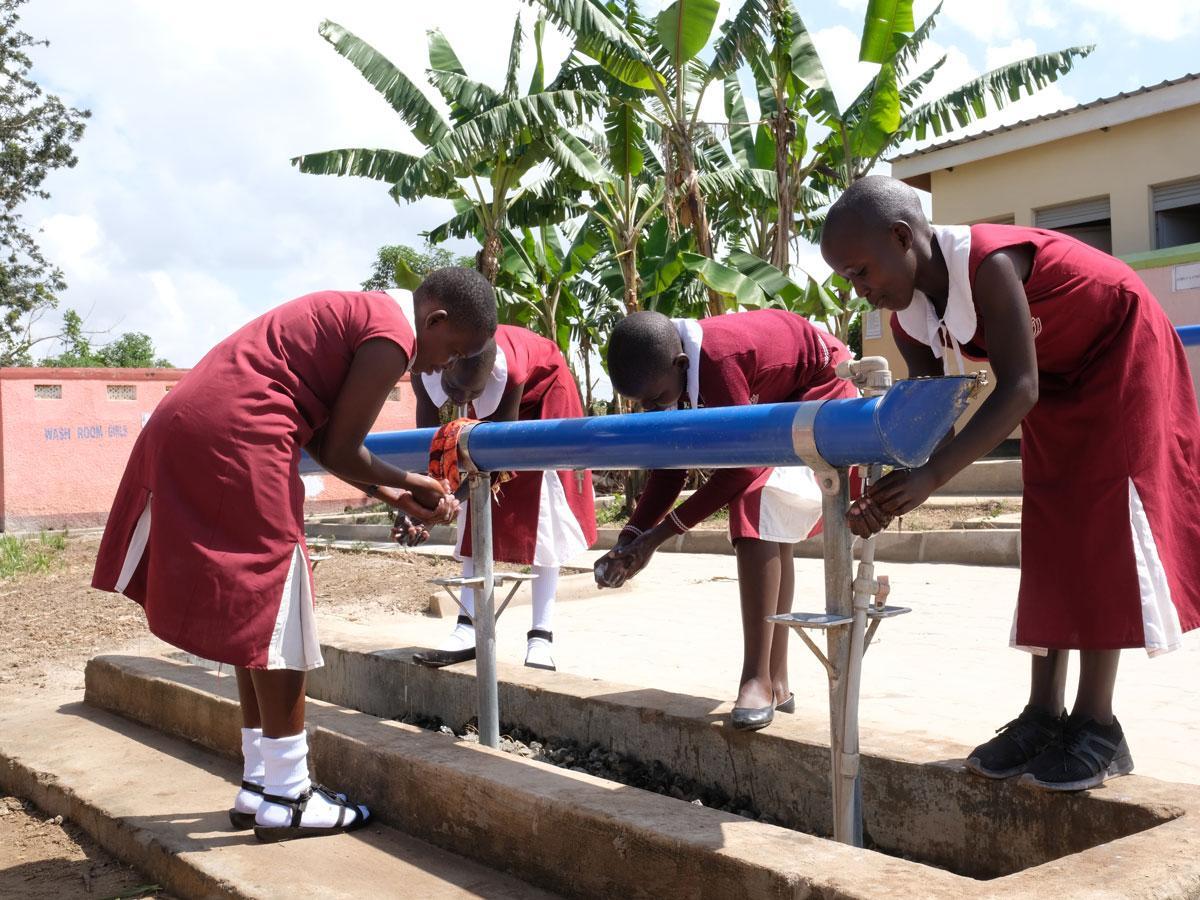
There is no danger of that with Mary Ayugi. Together with her classmates, the self-assured 11-year-old has just recited a poem about menstrual hygiene and toilets – and there were no giggles. Now she is showing the visitors around the school’s new toilets. The girls’ toilets also have a changing cubicle. If necessary, the girls can wash, clean their clothes, wash re-usable sanitary towels, and hang them up to dry. There are also handwashing facilities outside, with space for lots of girls and boys.
Mary’s periods haven’t started yet, she tells us very frankly. But she feels that the school has prepared her well and will provide her with support. ‘It’s just part of a woman’s body,’ she says. And it sounds perfectly natural.
Focus on women and children
Sanitation for Millions supports partners in building female-friendly and inclusive sanitary facilities at public institutions and trains local specialists to operate and maintain them. It communicates knowledge about hygiene to all sections of society. The programme focuses particularly on disadvantaged and vulnerable groups like women and children. So far, around two million people have benefited directly from improved access to safe sanitary facilities.
