Frozen sunlight
Green economic recovery in action: a successful German-Indonesian project illustrates how renewable energy can boost the local economy in fishing villages across the archipelago – with solar-powered ice makers.

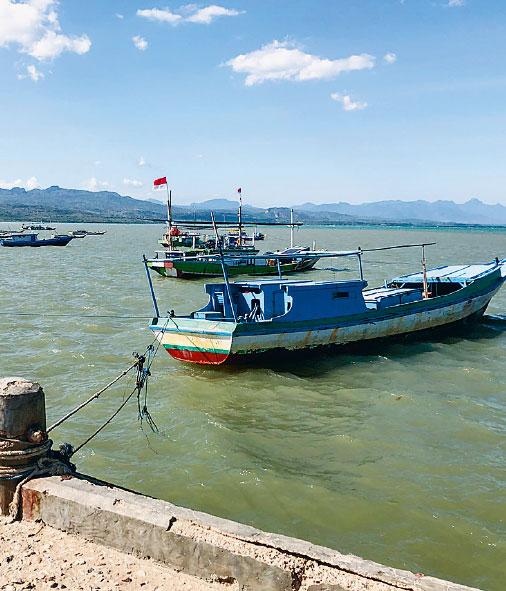
For years, fishers from Sulamu have had to make the daily journey south in their boats across Kupang Bay to fetch ice to keep their fish fresh. They can see the lights of Kupang, capital of the Indonesian province of East Nusa Tenggara, from the shores of their village. While Kupang has seen strong growth over the past two decades, little has changed in Sulamu. There is a mosque, a school, a few small stands selling goods along the village street and an old lighthouse. Sulamu is typical of the small villages on the Indonesian archipelago, which is made up of around 17,500 islands. It is well away from the big cities and the tourist hotspots on Java and Bali. The 1,500 inhabitants of Sulamu live very simple lives, most of them from agriculture, and above all from the sea. Many feed their families by harvesting seaweed and catching fish.
It is small-scale fishers such as those in Sulamu, employing traditional methods, who are vital to preserving Indonesia’s rich marine biodiversity. Sustainable practices, for instance using longlines or fish traps, prevent overfishing and by-catch. Across the country, around 80 per cent of the people in the fisheries sector work in family-run enterprises. Without effective and affordable cooling for their catch, however, they usually have no access to economically significant markets. Large-scale industrial fishing is the big volume business – and it is big: Indonesia is the world’s second largest fish producer.


Without ice, fish will go off
In these small-scale fisheries, the level of freshness is not good enough for export, and it is not always possible to sell everything locally, either. Block ice for the boats from Sulamu can only be obtained from the cooling plants in Kupang. It has to be reserved days in advance, and there is not always enough available. In that case, the fishers of Sulamu have to go without. ‘Sometimes they have to throw 15 tonnes of fish away because it has gone off, for lack of cooling facilities,’ says Gabriel Kennenbudi, who comes from the region and is familiar with the problems the people have. When a university friend told him about the idea for an ice-making machine powered by the sun, the 54-year-old decided to invest in the pilot project for the solar ice maker.
Kennenbudi works full time at the administrative authority in Kupang. The graduate engineer is interested in new technologies and has provided funding for the building in Sulamu where, from 2022 onwards, the solar ice maker will produce up to 1.2 tonnes of ice blocks every day, depending on the amount of sunshine. That means 120 blocks, each weighing 10 kilograms. The photovoltaic modules have already been mounted on the roof of the small factory building, and the refrigeration system will be fitted by the end of 2021. Installation had been delayed by the pandemic and its travel restrictions and lockdowns, but everyone involved kept driving the project forward all the time.
The solar ice maker is a vivid example of what a green economic recovery can look like, in particular for the post-pandemic period. A recovery that leaves no one behind, and a true win-win situation, thinks Dadan Kusdiana, Director General of New, Renewable Energy and Energy Conservation at Indonesia’s Ministry of Energy and Mineral Resources, the project’s political partner. Rural productivity will improve, he says, small-scale fishers’ incomes will rise and at the same time Indonesia can reach its climate targets faster by cutting CO2 emissions. Dadan Kusdiana is full of praise: ‘Solar cooling, and the solar ice maker technology in particular, will contribute to the green recovery of Indonesia after the pandemic.’

But how does the solar ice maker work? Ice is produced from the power of the sun, making the whole process climate neutral. The crux was to combine solar and refrigeration technology in one system as effectively as possible, because while solar energy is plentiful in tropical Indonesia, solar modules provide only a limited amount of electricity. This is why the refrigeration system uses a highly efficient motor and high-tech fans. In designing the fans, the engineers found inspiration from the wings of owls, which fly particularly quietly and thereby save energy. Furthermore, an intelligent energy management system and sensor technology enable ice production to be dynamically and automatically adjusted to the amount of solar energy available. It is a technological marvel that requires neither a power connection nor a large storage battery.
In specific terms, the pilot plant in Sulamu alone will save 40 tonnes of CO2 a year, thanks to annual savings of around 14,000 litres of diesel for electricity generation and transporting ice. At the same time, cooling prevents valuable fish from going off. Small businesses can successfully bring their chilled catch to market. For tuna alone, the price of chilled, high-quality produce is over two-and-a-half times as high as that of poor-quality fish. Over the course of a year, this works out at greater added value of at least EUR 60,000 at each location. This extra money could be available to the fishing families in future – perhaps to invest in their children’s education.
‘It couldn’t be better,’ says Steffen Sinn, who is responsible for the South-East Asian market at German fan manufacturer Ziehl-Abegg. ‘I was enthusiastic right from the outset, because I know Indonesia well. Anything that improves people’s lives while also helping to mitigate climate change makes the world more liveable.’
Far-sighted initiative
Indonesia is the world’s largest island nation and is particularly affected by climate change. After the coronavirus pandemic, this South-East Asian country would like to focus on green investment and jobs, and use renewable energy to boost rural productivity. One way in which GIZ is contributing is by supporting the distribution of solar ice makers. Development started in 2016, as an integral part of the Indonesian-German energy programme that had a number of different projects and commissioning parties, including the German Development Ministry (BMZ). Currently the initiative is anchored in the ExploRE project (Strategic Exploration of Economic Mitigation Potential through Renewables), which was commissioned by the German Environment Ministry (BMU). It is also supported by Germany’s COVID-19 recovery stimulus packages.
Contact: Frank Stegmüller, @email
The company is based in Baden-Württemberg, south-west Germany, and is one of nine private enterprises that have cofinanced the solar ice maker and brought it to fruition. ‘We are relying on the multiplier effect and hope that the solar ice maker will provide energy-efficient, green cooling in other remote regions of the world too.’ Frank Stegmüller, who is responsible for the innovative ice makers at GIZ, is similarly optimistic: ‘There is huge potential for this outstanding technology in Indonesia with its 540 small local ports.’
GIZ launched the project back in 2016. Even then – years before the pandemic – the main concern was how to boost traditional small-scale fishing in Indonesia on a sustainable basis and create local jobs. It quickly became clear that block ice, made using local renewable energy, can help leverage development. With GIZ acting as the coordinator, the German Institute of Air Handling and Refrigeration (ILK) in Dresden took on the task of developing a special solar-powered ice maker and subsequently transferring the technology to Indonesia so that production could be set up locally.

Indonesia in brief
‘The ILK team in Dresden did an outstanding job and got to grips with the conditions in Indonesia,’ Frank Stegmüller explains. GIZ looked for appropriate partners, established production with local, German and European companies in Indonesia and made sure that communication between everyone involved was clear and transparent.
The pilot project can be used to publicise the solar ice maker in years to come. GIZ is currently working with the International Pole & Line Foundation, a maritime non-governmental organisation, to press ahead with dissemination of the machine. From now on, manufacturing will be handled by the Indonesian industrial enterprise Selaras Mandiri Tehnik (SMT). This will create sustainable, green jobs locally, and for the long term – not only in Java, Indonesia’s political and economic centre, but also in far-off Sulamu.
As Gabriel Kennenbudi points out, ‘ice production also offers new employment opportunities for young people in the village.’ The investor is still thinking ahead, and would like to create a central contact hub for fishers around the ice production site where they can find everything they need, from fishing permits to fuel and all their equipment. ‘Once we have got going, I hope that more people will be interested in making environmentally friendly investments here,’ he adds.
First of all, anyway, the fishers of Sulamu will no longer have to chug across Kupang Bay to pick up ice blocks to stop their catch from spoiling. That’s a good start.