Every dose counts
Vaccines need to be kept cold for them to be effective. A pilot project in Malawi is demonstrating how that can work using digital tools and solar power even in remote african villages.

Under the shade of a mango tree, Wellington Chafulumira bends down to administer a vaccine in a restless baby’s thigh, as her mother tries to hold her still. As the local health assistant based in Kalungama village, he’s responsible for the monthly outreach clinic giving childhood vaccinations. The children receive their basic vaccinations against diseases such as measles, mumps and rubella here. It’s hot work in the searing temperatures on the southern shore of Lake Malawi, and a group of mothers and babies patiently wait their turn in the shade, sitting on the parched earth.
In remote villages like Kalungama, where there is no constant power supply or refrigeration, it is a huge challenge to ensure that the ‘last mile’ of the cold chain is properly maintained. Vaccines require continuous refrigeration – from production to use – to ensure their effectiveness and avoid waste. Kalungama is 13 kilometres away from the nearest health centre in Bilira, and Samuel Mtalimanja, Senior Disease Control Officer, had a very early start to deliver the vaccines to Wellington. After 23 years in the job, he’s used to the challenges of dawn starts. Recently, however, life has got a bit easier with the arrival of five insulated vaccine carrier boxes that help to keep the vaccines cool.


These cool boxes are part of the emmunize project, partly funded by the Merck Family Foundation and being piloted by GIZ in Bilira. The health station lies in Malawi’s Central Region, one of the poorest areas of one of the poorest countries in the world.
The project aims to ensure more efficient immunisation in rural areas by combining reliable and environmentally sound cooling devices with user-friendly digital tools. It was initiated by winners of the GIZ Innovation Fund. The emmunize project was developed by a global team of health experts, doctors, environmental engineers and political scientists who specialise in off-grid cold chain technology and green cooling solutions designed to protect the climate and the environment.
These innovations are now being used around Bilira: the cool box sensors wirelessly monitor the temperatures of carriers throughout mobile outreach sessions and send live data to an app. ‘This will help us a lot because we will be sure that the vaccines are always kept at the right temperature,’ says Samuel.

Malawi in brief
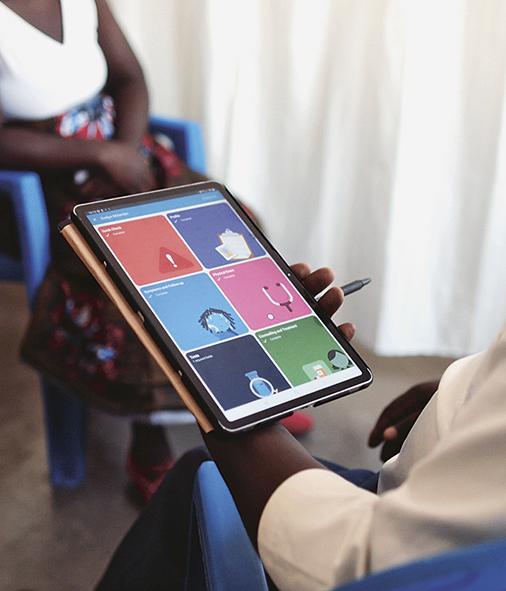
The emmunize app is linked to Malawi’s new electronic patient register, which is also being tested in the Bilira region. While Wellington Chafulumira is vaccinating the children, his colleague Olipah Chabwera sits with a tablet in front of her, calling up a child’s records on the electronic patient register and updating them with information about the jabs they have just received.
In the past, vaccination records were kept manually, and it was often difficult for health workers to access paper records or keep them up to date. The old records were impractical and not always to hand. Now, however, the emmunize app stores and updates all of the key information on children’s immunisation schedules and allows easy tracking of outstanding vaccines. It also helps health workers to plan outreach sessions more effectively since it generates more accurate attendance lists and calculates the amount and type of vaccines required for specific clinics in the communities.
Improved diagnoses due to digital innovations
In Bilira, the medical team is proud of the digital innovations. ‘We were chosen for the pilot because Bilira was a fairly typical rural health centre with basic facilities and poor power supplies,’ says Emmanuel Gawanika, Senior Health Surveillance Assistant. ‘Now it is to become a centre of excellence for improved services and data collection – setting an example for others.’
The electronic patient register, which is being tested for a potential rollout throughout the country, is currently already in use at Bilira’s paediatric clinic, in antenatal and postnatal care and in the delivery room. Staff have been equipped with handheld tablets. In addition to keeping medical records, the integrated system also provides simple treatment guidelines, based on WHO standards, which help with timely and accurate diagnosis and treatment.
Added value for health
GIZ is supporting Malawi’s Ministry of Health in setting up a pioneering electronic patient register. Commissioned by BMZ, the project receives funding from the Bill and Melinda Gates Foundation. It is cooperating with Jembi, a South African non-governmental organisation that develops digital transformation programmes for the health sector, and the IT company Ona, which is devising open source solutions to adapt the system to Malawi’s existing digital structures. The Health Information System Programme (HISP) Malawi, which is responsible for introducing the health information system (DHIS2), is also involved in the project. Integrating the electronic patient register into this national health information system will be extremely useful, as it will mean that more precise data is rapidly available that can be used both for nationwide statistics and for work carried out by experts at local level.
Contact: Kai Straehler-Pohl, kai.straehler-pohl@giz.de
At the health centre in Bilira, a shelter for vaccinating children under five has also been built and is equipped with an environmentally friendly solar-powered refrigerator (SolarChill) that works without batteries. It is used to store vaccine doses before they are transported to the villages in the cool boxes. Health workers are being trained on how to use and maintain the equipment to ensure its long-term operation. The installation of solar panels means that power blackouts can be avoided.
50 per cent fewer wasted vaccines
For Samuel Mtalimanja, the changes in Bilira have already started to have a visible impact. The number of vaccine doses that have to be disposed of due to cooling and storage problems has halved. This means that more doses are available, which is helping to protect babies and toddlers more effectively. ‘We used to run out of vaccines every month in the past. But now the e-register makes it easier to plan and order the vaccines we need to avoid stockouts,’ Samuel explains. Although the e-register and the emmunize app are currently only in use in Bilira, Stephen Macheso, Director of Health and Social Services in the district of Ntcheu, believes both patients and health workers have benefited enormously. ‘This is the way to go for the whole country. We need to move quickly in this direction to make sure the whole health system becomes more efficient and effective.’
The monitored cool boxes will help us to keep COVID vaccines cool and get them out into remote villages.
As the sun dips in the sky over Kalungama, Samuel Mtalimanja and his colleagues pack up after a long day of vaccinations. The improvements brought about by the emmunize app and the cooling system mean that the vaccines are used effectively. Mothers carry their sleepy babies on their backs to their huts, happy that they are part of a new way to improve the health of babies, toddlers and mothers in Malawi.